
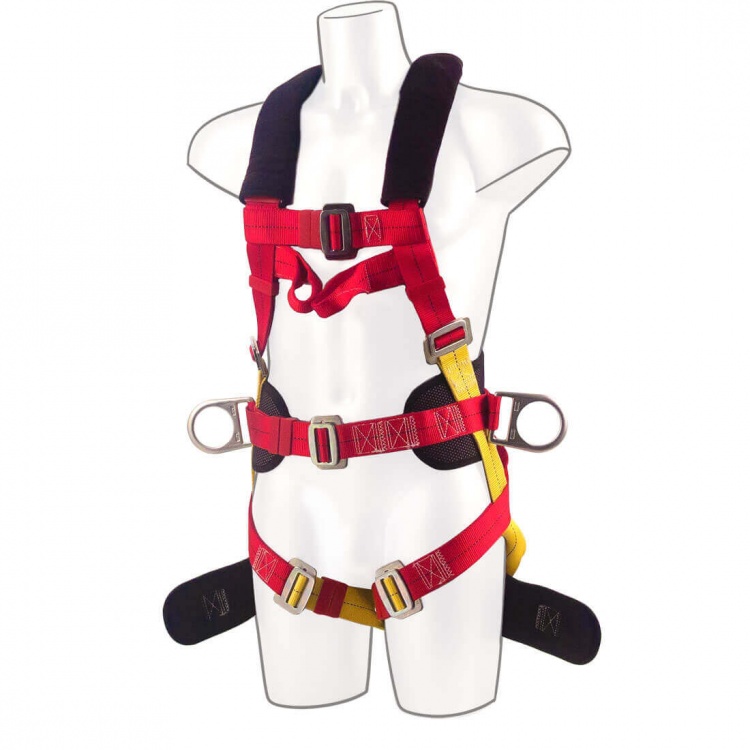
Fall Arrest Harnesses: A Guide to Safe Working at Height
A fall arrest harness is a key part of personal protective equipment (PPE) for people who may be at risk of falling while working at height. It is designed to distribute the forces of a fall across the body and connect the wearer to a suitable fall arrest system. However, a harness does not prevent a fall on its own: safe use depends on the right equipment, correct fitting, suitable anchorage and a clear rescue plan.
What is a fall arrest harness?
A fall arrest harness is a full-body harness with attachment points for connecting to compatible equipment, such as a lanyard, energy absorber or fall arrester. In a fall arrest system, this equipment is intended to stop a fall and limit the forces acting on the wearer.
Harnesses used for fall arrest should meet the relevant requirements of BS EN 361. Other components must also be suitable for the task and compatible with the harness. For example, energy-absorbing lanyards are commonly covered by BS EN 355, while connectors and anchor devices have their own relevant standards.
Fall arrest and fall restraint
Fall restraint and fall arrest are not the same. A restraint system is set up to prevent a worker from reaching a position where they could fall. A fall arrest system allows the possibility of a fall but is designed to stop it safely. Where practicable, preventing access to the edge or using a restraint system is generally preferable to relying on fall arrest.
Choosing the right harness and equipment
The equipment should be selected following a suitable risk assessment and by someone with the knowledge to assess the task. Consider:
- The work activity: The harness and connection system must suit the task, environment and duration of use.
- Attachment points: Use only the attachment point specified by the manufacturer for the intended purpose. A rear dorsal attachment is commonly used for fall arrest, but the instructions for the particular harness must be followed.
- Compatibility: Harnesses, lanyards, connectors and anchor devices must work together as a complete system.
- Fall clearance: There must be enough clear space below the worker to prevent them striking the ground or an obstruction. Account for lanyard length, energy absorber deployment, harness movement and the worker’s height.
- Edges and sharp surfaces: Standard equipment may not be suitable for use over an edge. Check that the system is approved for the expected conditions.
- Fit and comfort: The harness must be suitable for the wearer and adjustable enough to fit correctly over the clothing required for the task.
Do not choose equipment solely by its appearance or assume that components from different systems can be combined. Follow the manufacturers’ instructions and seek competent advice where compatibility or suitability is uncertain.
How to fit a fall arrest harness
Read the harness instructions before use. A typical fitting process includes the following steps:
- Check that the harness is the correct size and that it has passed its required inspections.
- Hold it by the dorsal attachment point and untangle the straps.
- Put on the shoulder straps and fasten the leg and chest straps as instructed by the manufacturer.
- Adjust each strap so it is secure and close-fitting without restricting normal movement or breathing.
- Check that buckles are properly fastened, straps are not twisted and loose ends are secured.
- Ask a trained colleague to check the fit if required by site procedures.
A poorly fitted harness can move during a fall, increase the risk of injury or make suspension more dangerous. The wearer should be trained to put it on, adjust it and check it correctly.
Inspection and care
Inspect the harness before each use, following the manufacturer’s guidance. Look for damaged webbing, cuts, abrasion, fraying, burns, chemical contamination, loose or damaged stitching, corrosion, distorted buckles and illegible labels. Inspect all connected equipment as well.
If equipment has arrested a fall, is damaged, has been involved in an incident or has an unclear history, take it out of service immediately. Do not use it again unless a competent person has assessed it and confirmed that it is safe. Formal examination and inspection arrangements should follow the manufacturer’s instructions and the employer’s procedures.
Store and clean the harness as directed by the manufacturer. Avoid unauthorised repairs, modifications, harsh cleaning products and storage conditions that could damage the materials.
Training, planning and rescue
Anyone using a fall arrest harness needs appropriate instruction and practical training. This should cover equipment selection, fitting, pre-use checks, safe connection and the limits of the system.
A fall arrest system must be supported by a practical rescue plan. A worker left suspended in a harness may suffer serious harm, so rescue arrangements should be prompt and specific to the worksite. Do not assume that the emergency services will be able to carry out a rapid rescue. Workers should know what to do, who to contact and what rescue equipment is available.
UK safety responsibilities
In the UK, work at height is governed by the Work at Height Regulations 2005. Employers and those in control of work must plan and supervise work at height, use competent people and select suitable equipment. The regulations require work to be organised to prevent falls where reasonably practicable; where a fall risk remains, appropriate measures must be taken to minimise the distance and consequences of a fall.
A fall arrest harness is only one part of a safe system of work. The safest approach is to assess the risks, avoid work at height where possible, use collective protection where practicable and rely on personal fall protection only when it is suitable for the task.
Key points
- Use a fall arrest harness as part of a complete, compatible system—not as a standalone safety measure.
- Choose equipment for the task and check that there is sufficient fall clearance.
- Fit the harness correctly and inspect it before every use.
- Follow the manufacturer’s instructions and remove questionable equipment from service.
- Provide suitable training and a realistic rescue plan before work begins.
This article is general information, not a substitute for a task-specific risk assessment, competent instruction or the manufacturer’s guidance.
9 Essential Tips for Safe Use of a Fall Arrest Harness
- Use a full-body harness designed for fall arrest.
- Choose a harness that fits snugly and comfortably.
- Inspect it before each use for wear, damage or defects.
- Check labels and follow the manufacturer’s instructions.
- Use only compatible lanyards, connectors and equipment.
- Attach to a suitable, secure anchorage point.
- Allow enough clearance below to prevent hitting the ground.
- Stay connected while exposed to a fall risk.
- Have a rescue plan and trained help ready.
Use a full-body harness designed for fall arrest.
Use a full-body harness specifically designed for fall arrest, rather than a work-positioning or restraint harness that may not be suitable for stopping a fall. Check the manufacturer’s instructions and make sure the harness is correctly fitted, compatible with the rest of the fall arrest system and appropriate for the task.
Choose a harness that fits snugly and comfortably.
Choose a fall arrest harness that fits snugly and comfortably. It should sit securely against your body without restricting your movement or breathing, and the straps should not be twisted or loose. A correctly fitted harness is less likely to shift during a fall and can help reduce the risk of injury. Always follow the manufacturer’s instructions and check the fit before each use.
Inspect it before each use for wear, damage or defects.
Before each use, inspect the fall arrest harness carefully for signs of wear, damage or defects. Check the webbing, stitching, buckles, straps and labels, looking for cuts, fraying, abrasions, corrosion or anything else that could affect its strength or fit. If you find a problem—or are unsure about the harness’s condition—do not use it; remove it from service and ask a competent person to assess it.
Check labels and follow the manufacturer’s instructions.
Before using a fall arrest harness, check that its labels are present, legible and show the required identification and safety information. Follow the manufacturer’s instructions for fitting, adjustment, connection, inspection, cleaning and storage, and make sure the harness is used only for its intended purpose. If the labels are missing or unreadable, or you are unsure how to use the harness safely, take it out of service and seek advice from a competent person.
Use only compatible lanyards, connectors and equipment.
Use only lanyards, connectors and other equipment that are compatible with your fall arrest harness and approved for the task. Components that do not work together correctly may disconnect, fail or prevent the system from arresting a fall safely. Always check the manufacturers’ instructions, including the specified attachment points and any limits on use, and ask a competent person if you are unsure.
Attach to a suitable, secure anchorage point.
Always attach your fall arrest harness to a suitable, secure anchorage point that is capable of withstanding the forces generated in a fall. The anchor must be appropriate for the task, correctly positioned to reduce fall distance and the risk of swinging into an obstacle, and compatible with the rest of the system. Follow the equipment manufacturer’s instructions and your site’s safety procedures; if you are unsure whether an anchorage point is suitable, do not use it until a competent person has checked it.
Allow enough clearance below to prevent hitting the ground.
Always check that there is enough clear space below you before using a fall arrest harness. If a fall occurs, the lanyard and energy absorber may extend, while the harness and your body will also move downwards. Allow for these factors, your height and any obstacles below, and follow the equipment manufacturer’s guidance. If there is not enough clearance, choose a safer work method or a suitable alternative system.
Stay connected while exposed to a fall risk.
Stay connected whenever you are exposed to a fall risk. Before moving or changing position, make sure your fall arrest system remains securely attached to a suitable anchor point, using an appropriate connection method that avoids becoming disconnected. Follow your training and the equipment manufacturer’s instructions, and never unclip unless you are in a safe area or have another secure connection in place.
Have a rescue plan and trained help ready.
Before anyone works at height in a fall arrest harness, make sure there is a clear, practical rescue plan and trained help ready to act. A person left suspended after a fall may be at serious risk, so rescuers should know their roles, have suitable equipment available and be able to respond promptly. Do not rely on the emergency services as the only rescue plan.
Tags: anchorage, bs en 361, energy absorber, equipment compatibility, equipment maintenance, fall arrest harness, fall arrest system, fall arrester, fall clearance, fall restraint, full-body harness, harness fitting, lanyard, personal fall protection, personal protective equipment, ppe, pre-use inspection, rescue plan, risk assessment, training, uk safety regulations, work at height regulations 2005, working at height