
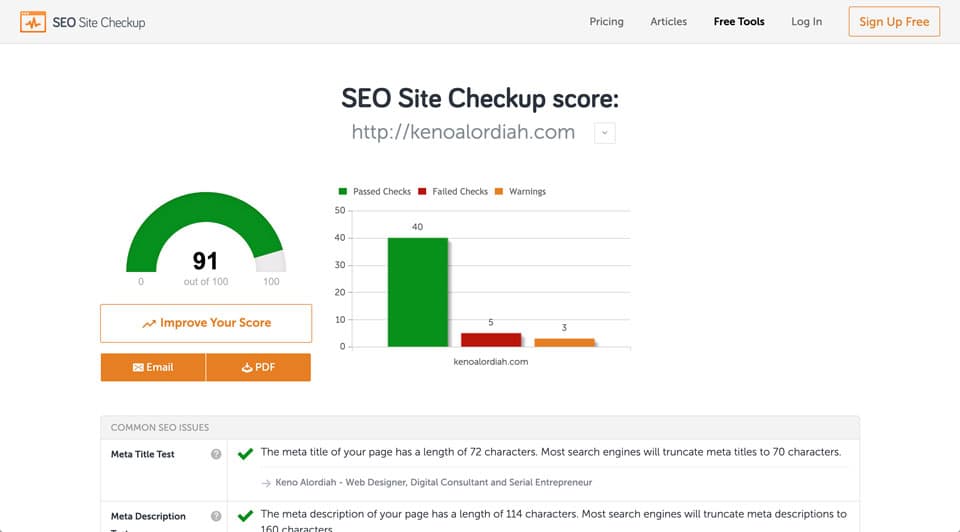
SEO Audit Score: What It Means and How to Improve It
An SEO audit score is a quick indication of how well a website meets a set of search engine optimisation checks. It can help highlight technical problems, content gaps and opportunities to improve. However, it is not a direct Google ranking factor, and a high score does not guarantee better rankings or more visitors.
Different SEO tools use different checks and scoring systems. Treat the score as a starting point for investigation rather than a definitive verdict on your website.
What does an SEO audit score measure?
An SEO audit may assess several areas of a website, including:
- Technical SEO: whether pages can be crawled and indexed, and whether the site has issues such as broken links, redirect errors or duplicate pages.
- On-page SEO: the use of page titles, meta descriptions, headings, image alt text and descriptive URLs.
- Content: whether pages are useful, clear, relevant to their intended audience and sufficiently distinct from other pages on the site.
- Mobile usability: how well pages work on phones and tablets.
- Site performance: factors that affect loading and page responsiveness.
- Security: whether the site uses HTTPS and is configured safely.
- Links: internal links between pages and, in some audits, external links pointing to the site.
Some tools combine these checks into one overall score. Others provide separate scores for technical health, content, performance or backlinks. Because each tool has its own methodology, scores from different platforms may not be directly comparable.
Is a higher SEO audit score always better?
Not necessarily. A score can be useful for tracking progress in the same tool over time, but it cannot capture every aspect of search performance. For example, an audit might reward the presence of certain tags, while overlooking whether a page genuinely answers a visitor’s question.
Search rankings also depend on factors that a standard audit may not fully assess, such as the quality and relevance of competing pages, the reputation of a business and the intent behind a search. A technically tidy website can still struggle if its content is unhelpful or does not match what people are looking for.
Focus on fixing meaningful issues, not on chasing a perfect score.
How to interpret your score
Start by checking how the audit tool defines its score. Look at the individual findings and identify which pages are affected. A site-wide score can hide important differences: a handful of broken pages may matter more than minor warnings across hundreds of URLs.
Give priority to issues that:
- stop important pages from being crawled or indexed;
- make key pages difficult to use, particularly on mobile;
- affect many pages at once;
- make it harder for visitors to understand or navigate the site; or
- relate to pages that support your main business goals.
It is also worth checking audit findings manually. Automated tools can produce false positives, miss context or flag recommendations that are not appropriate for every website.
How to improve your SEO audit score
Fix critical technical issues
Check that important pages return the correct status code, can be reached through internal links and are not accidentally blocked from search engines. Review your XML sitemap and robots.txt file, and investigate duplicate or redirected URLs. Make changes carefully: removing or redirecting pages can affect visitors and search visibility if done without a plan.
Improve page titles and descriptions
Write a clear, unique title for each important page. It should describe the page accurately and help readers understand what they will find. Meta descriptions do not directly determine rankings, but a useful description may encourage people to choose your result.
Make content more useful
Review pages with thin, outdated or unclear content. Make sure each page has a clear purpose, answers the reader’s likely questions and provides information that is accurate and easy to understand. Avoid adding keywords unnaturally just to satisfy an audit tool.
Strengthen internal linking
Link related pages together using descriptive anchor text. Good internal links help visitors find relevant information and help search engines understand how your pages relate to one another. Important pages should not be isolated from the rest of the site.
Check mobile usability and performance
Test key pages on a range of screen sizes. Make sure text is readable, navigation is usable and important content is not obscured. Review performance data and address issues that have a noticeable effect on the experience, such as oversized images or unnecessary scripts.
Monitor changes over time
After making improvements, run another audit using the same tool and compare the results. Track important pages and search performance as well as the overall score. This makes it easier to see whether changes are helping in practice.
Use an SEO audit score as a guide
An SEO audit score is most valuable when it helps you find and prioritise problems. It should sit alongside other evidence, including website analytics, search performance data and feedback from real users. Focus on making your site accessible, useful and technically sound, and use the score to measure progress rather than as the goal in itself.
6 Tips to Improve Your SEO Audit Score
- Treat the score as a guide, not a ranking guarantee.
- Fix critical technical issues first.
- Prioritise recommendations by impact and effort.
- Check that key pages are crawlable and indexable.
- Review page speed and mobile usability.
- Re-run the audit after making changes.
Treat the score as a guide, not a ranking guarantee.
Treat your SEO audit score as a useful guide to your website’s strengths and areas for improvement, not as a guarantee of higher search rankings. Audit tools use different checks and scoring methods, and no single score can reflect every factor that influences search performance. Focus on resolving issues that affect your visitors and important pages, then monitor rankings, traffic and engagement to see whether your changes are making a difference.
Fix critical technical issues first.
Fix critical technical issues first, as problems such as blocked pages, broken links, incorrect redirects or indexing errors can prevent search engines and visitors from reaching important content. Use your SEO audit to identify the issues affecting the most valuable pages, then resolve and retest them before moving on to lower-priority recommendations. This helps build a sound technical foundation for further SEO improvements.
Prioritise recommendations by impact and effort.
Prioritise SEO audit recommendations by weighing their likely impact against the effort required. Start with issues that could significantly affect important pages or many visitors, such as indexing problems or broken navigation, especially when they are straightforward to fix. More complex tasks may still be worthwhile, but plan them around your available time and resources. This approach helps you focus on practical improvements rather than trying to resolve every audit warning at once.
Check that key pages are crawlable and indexable.
Check that your key pages are both crawlable and indexable so search engines can discover and include them in search results. Review your robots.txt file, meta robots tags and page settings to make sure important content is not blocked or marked “noindex”. It’s also worth checking that these pages are linked from elsewhere on your site and included in your XML sitemap.
Review page speed and mobile usability.
Review page speed and mobile usability as part of your SEO audit, as slow-loading pages and difficult mobile experiences can frustrate visitors and affect how well your site performs in search. Test key pages on different devices, check that text is easy to read and navigation is simple to use, and identify anything slowing pages down, such as oversized images or unnecessary scripts. Prioritise fixes that make the biggest difference to real users, then check the results again.
Re-run the audit after making changes.
Re-run the SEO audit after making changes to check whether the issues have been resolved and to spot anything new. For a useful comparison, use the same audit tool and settings, and keep a record of your results. Remember to check key pages and search performance as well as the overall score, since a higher score alone does not guarantee better rankings or a better experience for visitors.
Tags: backlinks, content quality, crawling and indexing, google rankings, internal links, meta descriptions, mobile usability, on-page seo, page titles, search engine optimisation, search performance, seo audit score, seo audit tools, seo improvements, site performance, technical seo, user experience, website analytics, website security