
Google SERP Analysis: How to Understand Search Results and Improve Your SEO
Google SERP analysis is the process of examining search engine results pages to understand what Google shows for a particular query and what searchers are likely looking for. SERP stands for “search engine results page”. By studying the results, businesses and content creators can make better decisions about which keywords to target, what content to publish and how to improve their visibility in search.
It is not simply a matter of checking which websites rank first. A useful analysis looks at the type of pages that appear, the features Google displays, the likely intent behind the search and the strengths and weaknesses of competing content.
Why analyse Google SERPs?
Keyword research can identify the phrases people use, but it does not always reveal what they expect to find. Two searches with similar wording may produce very different results. One might be dominated by product pages, while another features guides, videos or local businesses.
SERP analysis helps you:
- Understand the intent behind a search query.
- Choose the most suitable format for a page.
- Identify topics and questions that competing pages cover.
- Spot opportunities in featured results and other SERP features.
- Assess how difficult it may be to compete for a query.
- Improve existing pages that are not attracting the expected traffic.
What can appear on a Google results page?
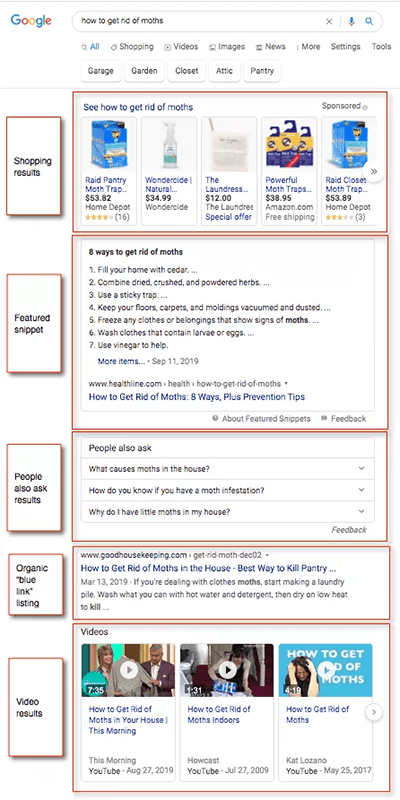
Google’s results pages can contain more than the familiar list of blue links. Depending on the query, location, device and other factors, a SERP may include:
- Organic web page listings.
- Sponsored adverts.
- Featured snippets or direct answers.
- Local results, including a map and business listings.
- Image and video results.
- News stories.
- Product listings and shopping results.
- “People also ask” questions.
- Knowledge panels and other information features.
The features shown can affect how much attention organic listings receive. For example, a page may rank well but still attract fewer clicks if adverts or prominent answer features take up much of the screen. This is one reason rankings should be considered alongside impressions, clicks and the layout of the results page.
How to carry out a Google SERP analysis
Choose a specific search query
Start with the keyword or phrase you are considering targeting. Analyse the exact wording, as small differences can change the results. For instance, a search for “running shoes” may have a different intent from “best running shoes for beginners” or “how to choose running shoes”.
It can also be useful to examine related phrases. These can reveal whether one page could answer several closely connected searches or whether separate pages are needed.
Search in the right context
Google results can vary according to location, language, device and search history. If you are targeting customers in the UK, assess the results from a UK perspective. Consider whether your audience is likely to search on a mobile or desktop device, and check local results where location matters.
Private browsing can reduce some personalisation, but it does not make results completely neutral. Search location and other contextual factors may still influence what appears. For more consistent tracking, use a rank-tracking platform or Google Search Console data, while remembering that both have their own limitations.
Identify the search intent
Search intent is the reason behind a query. A useful starting point is to classify it as one of the following:
- Informational: the searcher wants to learn something, such as “how does solar power work?”
- Navigational: the searcher is looking for a particular organisation, website or service.
- Commercial investigation: the searcher is comparing options before making a decision, such as “best broadband deals”.
- Transactional: the searcher is ready to take an action, such as buying a product or booking a service.
Look at the pages Google ranks and ask what they have in common. Are they guides, category pages, product pages, comparison articles or local business listings? The result types offer strong clues about what Google considers relevant to the query.
Record the main SERP features
Note which features appear above or among the organic listings. A featured snippet, local pack, video carousel or shopping module may suggest an opportunity to create suitable content or improve an existing page. It may also indicate that the search is answered in more than one way.
Do not assume that every feature is worth pursuing. Consider whether it matches your audience, your website and your business goals. A video carousel, for example, is most relevant if video is a natural format for the subject.
Review the top-ranking pages
Study several of the pages that rank prominently. Look at their:
- Page type and content format.
- Title, headings and overall focus.
- Topics, questions and subtopics covered.
- Use of images, video, tables or other helpful elements.
- Publication or update dates, where shown.
- Reputation and apparent expertise in the subject.
- Internal links and calls to action.
The aim is not to copy competing pages. Instead, identify what searchers are being offered and where your own page could provide a clearer, more useful or more complete experience.
Look for content gaps and opportunities
Compare the top results with your existing or planned content. Are important questions left unanswered? Is the information difficult to follow? Could the topic be explained with a practical example, original data, an expert perspective or a more suitable format?
A content gap is only valuable if it helps the reader. Adding extra words or repeating keywords will not automatically make a page better. Focus on accuracy, usefulness, clear organisation and evidence that supports the information.
Assess the level of competition
Ranking difficulty is not determined by one metric. Consider the quality and relevance of the pages currently ranking, the authority of the websites, the strength of their links and how closely their content matches the query. Also consider whether the results are dominated by major brands, official sources or highly specialised sites.
Third-party SEO tools can provide estimates of keyword difficulty, search volume and link data. These are useful for comparison, but they are not measurements supplied directly by Google and should not be treated as guarantees of future rankings.
Using SERP analysis to improve existing content
SERP analysis is useful not only when planning new pages but also when improving content that is already published. Google Search Console can help identify queries that generate impressions but relatively few clicks. Compare the page’s title and description with the intent and presentation of the current results.
If a page receives clicks but visitors do not engage or convert, the issue may be the page experience, the match between the content and the promise in the search result, or the suitability of the query itself. SEO performance should be assessed using relevant measures such as qualified visits, enquiries, sales and engagement—not rankings alone.
Common SERP analysis mistakes
- Focusing only on the first result: review a range of results to understand the wider pattern.
- Ignoring search intent: a well-written page can still struggle if it is the wrong type of page for the query.
- Copying competitors: use competing pages as evidence of what is working, not as templates to reproduce.
- Overvaluing a single ranking: rankings can vary by location, device and time.
- Chasing every SERP feature: prioritise features that are relevant to your audience and objectives.
- Treating SEO tool estimates as facts: use third-party figures as directional data rather than exact predictions.
- Forgetting the reader: optimisation should make content easier to find and use, not less natural or helpful.
A simple SERP analysis checklist
For each target query, record:
- The query and its close variations.
- The likely search intent.
- The page types that rank.
- The SERP features shown.
- The recurring topics and questions covered.
- What competing pages do well.
- Where a genuinely useful improvement is possible.
- How success will be measured after publication.
Conclusion
Google SERP analysis turns search results into practical evidence. It helps you understand what people may be looking for, what kinds of pages Google considers relevant and where your content could offer something more useful. By combining careful observation with sound keyword research and performance data, you can make more informed SEO decisions—without relying on rankings or tool estimates alone.
Unlocking SEO Success: 7 Advantages of Google SERP Analysis
- Reveals what searchers want.
- Clarifies search intent.
- Highlights ranking opportunities.
- Shows useful SERP features.
- Informs content planning.
- Helps assess competition.
- Supports better SEO decisions.
Challenges in Google SERP Analysis: Navigating Variability, Time Investment, and Competitive Dynamics
- Results vary by location, device and personalisation.
- SERP features can reduce organic click-through rates.
- Analysis can become time-consuming.
- SEO tools provide estimates, not exact data.
- High-ranking pages may change frequently.
- Competitor analysis can encourage imitation.
Reveals what searchers want.
Google SERP analysis reveals what searchers want by showing the types of pages and information Google ranks for a query. If the results are mainly practical guides, product comparisons or local listings, this offers a clear clue about the searcher’s intent. Understanding that intent helps you create content that answers the right questions, uses an appropriate format and better matches what people expect to find.
Clarifies search intent.
Google SERP analysis helps clarify search intent by revealing what people are hoping to find when they enter a particular query. By examining the pages and features Google displays, you can see whether searchers want practical information, product comparisons, a specific website or a service they can buy. This insight helps you create content that matches their needs, making it more useful to readers and more relevant to the search.
Highlights ranking opportunities.
Google SERP analysis highlights ranking opportunities by revealing where your website could compete more effectively in search results. By reviewing the pages and features that appear for a target query, you can spot gaps in the existing content, underserved questions and formats that Google appears to favour. This helps you focus on searches where a useful, well-targeted page has a realistic chance of standing out, rather than spending time on keywords that are already dominated by highly relevant or authoritative results.
Shows useful SERP features.
Google SERP analysis reveals which features appear for your target searches, such as featured snippets, local listings, image packs, videos and “People also ask” questions. These features show how Google presents information and what searchers may find useful, helping you choose the right content format and identify opportunities to make your pages more visible.
Informs content planning.
Google SERP analysis informs content planning by showing what people are looking for and which types of pages currently meet that need. Reviewing top results, related questions and SERP features can help you choose suitable topics, formats and headings, while revealing gaps your content could address. This makes it easier to create useful, relevant pages based on real search behaviour rather than guesswork.
Helps assess competition.
Google SERP analysis helps you assess the competition by showing which websites and page types already rank for your target search. Reviewing their content, relevance, authority and use of SERP features can reveal how challenging it may be to compete, as well as areas where your page could offer something more useful or distinctive. This makes it easier to prioritise realistic opportunities and shape content that better meets searchers’ needs.
Supports better SEO decisions.
Google SERP analysis supports better SEO decisions by showing what users are looking for and which types of content Google considers relevant for a search. By reviewing the pages and features that appear, you can choose suitable keywords, shape content to match search intent and spot opportunities to improve existing pages. This helps focus your time and resources on changes that are more likely to benefit both your audience and your search visibility.
Results vary by location, device and personalisation.
One drawback of Google SERP analysis is that results can vary depending on a searcher’s location, device and browsing history. Someone searching in London on a mobile phone may see different results from a person using a desktop in Glasgow, making it difficult to know which version reflects your wider audience. Personalisation and local factors can also affect rankings and SERP features, so a single search may give a misleading picture. For a more balanced assessment, compare results across relevant locations and devices, and treat them as a snapshot rather than a definitive view.
SERP features can reduce organic click-through rates.
One drawback of Google SERP analysis is that it can reveal how SERP features reduce organic click-through rates. Features such as featured snippets, local packs, image carousels and instant answers can take up prominent space on the results page, sometimes giving searchers the information they need without a click. As a result, a page may rank well but attract fewer visits than expected. This makes it important to look beyond rankings and consider impressions, clicks and the layout of the results when assessing SEO performance.
Analysis can become time-consuming.
A drawback of Google SERP analysis is that it can become time-consuming, particularly when reviewing many keywords or checking results across different locations, devices and search features. Comparing competitors, identifying search intent and recording changes all take care and attention. Without clear priorities, the research can consume time that would be better spent creating and improving useful content.
SEO tools provide estimates, not exact data.
One limitation of Google SERP analysis is that SEO tools provide estimates rather than exact data. Figures such as search volume, keyword difficulty and click potential are calculated using each tool’s own methods and may differ from actual search behaviour or Google Search Console data. Treat them as useful guides for comparing opportunities, not as guarantees, and support them with real performance data wherever possible.
High-ranking pages may change frequently.
One drawback of Google SERP analysis is that high-ranking pages can change frequently. Google regularly updates its search systems, while competitors publish new content and search trends shift, so a page that ranks near the top today may lose visibility tomorrow. This can make analysis quickly outdated and lead to SEO decisions based on a temporary snapshot. Rechecking results over time helps reveal lasting patterns, rather than prompting unnecessary changes in response to short-term fluctuations.
Competitor analysis can encourage imitation.
A potential drawback of Google SERP analysis is that studying high-ranking competitors can encourage imitation. It is useful to understand what works, but copying their topics, structure or approach may leave your content feeling generic and indistinguishable. Instead, use competitor analysis to spot what searchers expect, then add your own expertise, evidence and perspective to create something genuinely useful.
Tags: clicks, competitor analysis, content gaps, content optimization, featured snippets, google search console, google serp analysis, impressions, keyword difficulty, keyword research, local search results, organic search results, rank tracking, ranking difficulty, search engine results pages, search intent, search queries, search volume, seo, seo performance, serp features, user experience