
The Importance of Google PageRank in SEO
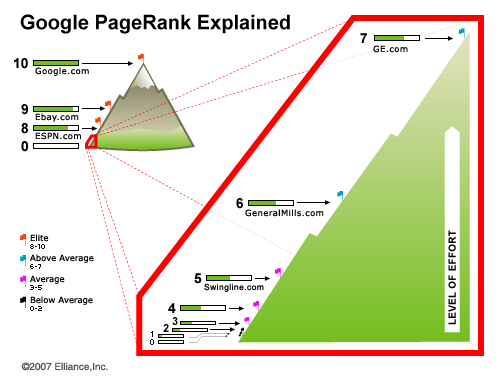
Google PageRank, named after Larry Page, one of the co-founders of Google, is an algorithm used by the search engine to rank web pages in its search results. While Google has officially stopped updating the PageRank metric, it still holds significance in the world of Search Engine Optimization (SEO).
PageRank works by evaluating the quality and quantity of links pointing to a web page. The more high-quality and relevant backlinks a page has, the higher its PageRank will be. In essence, it serves as a measure of a website’s credibility and authority in the eyes of Google.
Having a high PageRank can positively impact a website’s visibility in search engine results. Pages with higher PageRank are more likely to rank higher for relevant keywords, driving more organic traffic to the site. This can lead to increased brand awareness, higher conversion rates, and ultimately, better business success.
While Google no longer updates the public PageRank toolbar, it still uses the underlying algorithm as one of many factors to determine search rankings. Therefore, focusing on building quality backlinks and improving overall website authority can still have a significant impact on SEO performance.
In conclusion, while Google PageRank may not be as prominently displayed as it once was, its importance in SEO remains undeniable. Understanding how PageRank works and incorporating strategies to improve it can help websites achieve better visibility and success in search engine results.
8 Essential Tips to Boost Your Google Page Rank
- Create high-quality and relevant content for your website.
- Optimize your website’s on-page SEO elements such as meta tags, headings, and URLs.
- Build backlinks from reputable and relevant websites to increase your site’s authority.
- Improve your website’s loading speed to enhance user experience.
- Ensure your website is mobile-friendly for better accessibility on different devices.
- ‘Dwell time’ matters – keep visitors engaged with valuable content to increase their time on site.
- ‘Bounce rate’ should be low – make sure visitors find what they are looking for quickly and easily.
- ‘Click-through rate’ (CTR) can impact rankings – create compelling meta descriptions and titles to improve CTR.
Create high-quality and relevant content for your website.
Creating high-quality and relevant content for your website is a crucial tip for improving your Google PageRank. Content that is informative, engaging, and valuable to your target audience not only helps attract more visitors but also encourages other websites to link back to yours. Google recognises and rewards websites with quality content by boosting their PageRank, as it indicates credibility and authority in the eyes of the search engine. By consistently producing top-notch content that resonates with your audience, you can enhance your website’s visibility, drive organic traffic, and ultimately improve your SEO performance.
Optimize your website’s on-page SEO elements such as meta tags, headings, and URLs.
To improve your website’s Google PageRank, it is essential to optimise on-page SEO elements such as meta tags, headings, and URLs. By ensuring that these elements are relevant, descriptive, and contain targeted keywords, you can enhance the visibility and credibility of your web pages in search engine results. Meta tags provide search engines with information about the content of a page, while well-structured headings help to organise and prioritise content for both users and search engines. Additionally, incorporating keywords into URLs can further signal the relevance of your content to search engines, ultimately contributing to a higher PageRank for your website.
Build backlinks from reputable and relevant websites to increase your site’s authority.
To enhance your website’s authority and improve its Google PageRank, it is crucial to focus on building backlinks from reputable and relevant websites. Backlinks from high-quality sources signal to search engines like Google that your site is trustworthy and credible. By establishing connections with authoritative sites in your industry, you not only boost your own site’s credibility but also increase the likelihood of ranking higher in search engine results. Prioritising the acquisition of backlinks from reputable sources can significantly enhance your site’s visibility and overall performance in the competitive online landscape.
Improve your website’s loading speed to enhance user experience.
Improving your website’s loading speed is crucial not only for enhancing user experience but also for positively impacting your Google PageRank. A fast-loading website not only keeps visitors engaged and satisfied but also signals to search engines like Google that your site provides a good user experience. By optimising your website’s loading speed, you can improve your PageRank by providing a seamless browsing experience for users, which in turn can lead to higher search engine rankings and increased organic traffic.
Ensure your website is mobile-friendly for better accessibility on different devices.
Ensuring that your website is mobile-friendly is crucial for improving its accessibility across various devices, ultimately impacting your Google PageRank. With the increasing number of users accessing the internet through mobile devices, having a responsive design that adapts to different screen sizes and resolutions is essential. A mobile-friendly website not only provides a better user experience but also signals to search engines like Google that your site is up-to-date and user-focused. By prioritising mobile responsiveness, you can enhance your website’s usability, engagement, and ultimately, its chances of ranking higher in search results.
‘Dwell time’ matters – keep visitors engaged with valuable content to increase their time on site.
In the realm of Google PageRank, the concept of ‘dwell time’ plays a crucial role in determining a website’s ranking. Keeping visitors engaged with valuable and relevant content is key to increasing their time on site. By providing high-quality information that meets the needs and interests of users, websites can enhance dwell time, indicating to search engines that the content is valuable and engaging. This, in turn, can positively impact the website’s PageRank and overall SEO performance.
‘Bounce rate’ should be low – make sure visitors find what they are looking for quickly and easily.
Ensuring a low bounce rate is crucial for improving Google PageRank. A low bounce rate indicates that visitors are finding the information they need quickly and easily on a website. To achieve this, it is essential to have clear navigation, relevant content, and a user-friendly interface. By making sure that visitors can easily navigate the site and find what they are looking for, website owners can not only reduce the bounce rate but also increase user engagement and ultimately improve their site’s PageRank in search engine results.
‘Click-through rate’ (CTR) can impact rankings – create compelling meta descriptions and titles to improve CTR.
In the realm of Google PageRank, it is crucial to consider the impact of Click-through Rate (CTR) on search engine rankings. Crafting compelling meta descriptions and titles is essential in enticing users to click on your website link in search results. By creating engaging and relevant meta content, you can improve your CTR, which in turn can positively influence your website’s visibility and ranking on Google. Paying attention to these details not only enhances user experience but also signals to search engines the quality and relevance of your content, ultimately contributing to improved SEO performance.
Tags: algorithm, authority, backlinks, brand awareness, conversion rates, credibility, google page rank, headings, keywords, loading speed, meta tags, on-page seo elements, organic traffic, quality content, reputable websites, search engine, seo, site authority, target audience, urls, visibility, web pages, website success